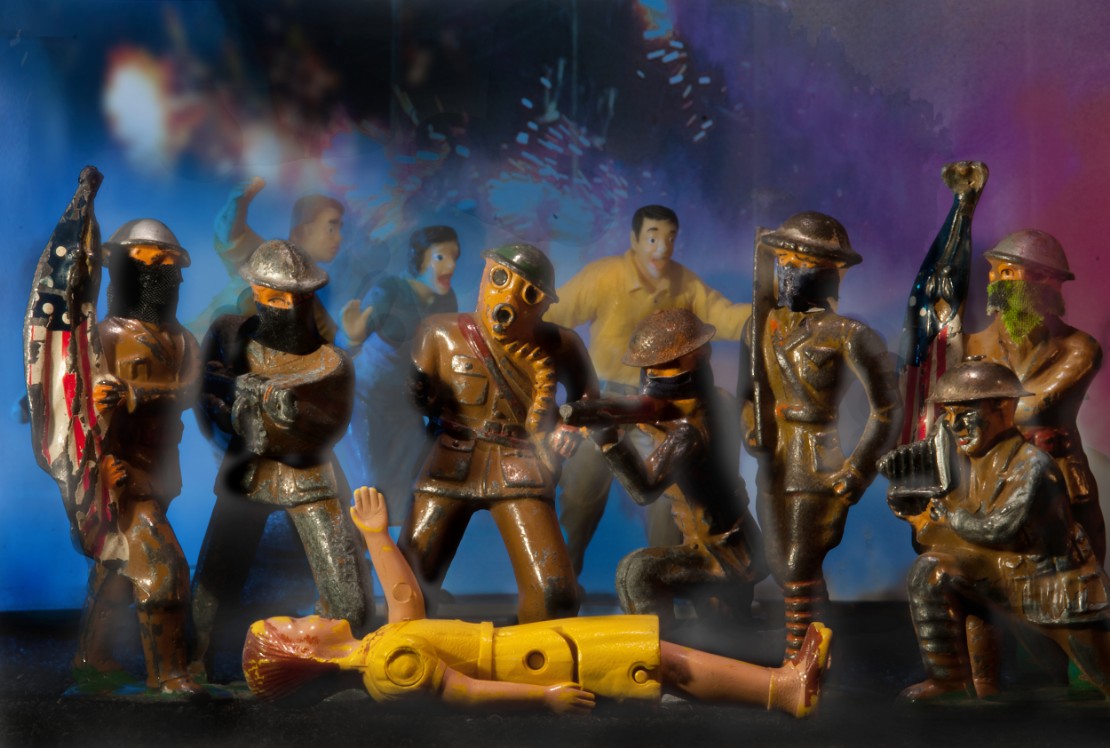
'Truth Has Died' (Murió la verdad)
Paul W Pearce
digital photo- 2026 - "20X30"
Paul W Pearce
digital photo- 2026 - "20X30"
I am angry, I am furious. Our country is at war with the world. Our country is in its own civil war. The responsibility lies squarely with the systems that historically protected and guided world order and has now been revealed to be fragile and corruptible.
There is no more rule of law. There is no more justice. Our "great" constitutions and charters are mere pieces of paper that can be ignored or misused. Terms like illegal, unlawful, unconstitutional, and unprecedented describe the actions of the rich and powerful, with no accountability. There are no checks on the lawless and nothing is in balance.
Truth is dying. Authorities spew outrageous lies that would be laughable if not so evil and dangerous.
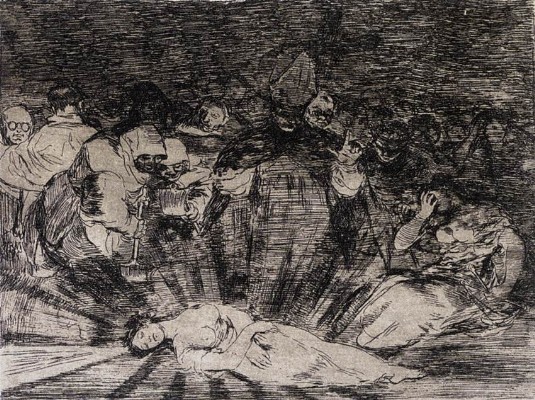
My image has an ominous predecessor. Two hundred years ago, Francisco Goya created a series titled "Disasters of War.” It defended liberalism and opposed the authority of King Ferdinand VII. He created an image, "Truth Has Died (Murió la verdad)," Illustrating a young woman, dead on the floor, who represents truth. Truth is being buried. She is considered dangerous because she threatens their wealth and privileges.
My anger stems from my upbringing and moral compass. I was brought up to respect authority and recognise right from wrong. My conscription and deployment to combat inflicted moral injury that I still suffer from. What I am witnessing now is wrong. That makes me furious and demoralised.
My question is: What makes these goons so angry? Angry enough to commit murder on city streets. Angry enough to traumatize innocent citizens and brutalise caring communities.
Authorities at the highest levels are ordering, condoning and lying about these atrocities.
Truth is dying.
Francisco Goya’s Truth Has Died (Murió la verdad)
The central figure of the etching is a young woman with bare breasts, dressed in white, who lies dead on the ground.[9] She is a clear allegory for "Truth" (la Verdad), but scholars also identify her as a representation of the 1812 Constitution.[10] Her body emits a radiant light, a traditional artistic device used to signify purity and divine or moral clarity.[11] Surrounding her is a grim assembly of figures:
- The Clergy: A group of friars and a bishop are shown preparing to bury her using hoes and spades.[12] This represents Goya’s critique of the Church’s role in supporting absolutism and suppressing intellectual freedom.[4] The clergy are depicted as being "happy to inter such a dangerous lady" because her existence threatened their traditional privileges and property.[10]
- Justice: To the right of the scene, a seated woman holding scales—the traditional attribute of Justice—weeps inconsolably.[13] In Goya’s vision, Justice is gagged and rendered powerless by the death of Truth.[10]
- The Witnesses: The background is filled with shadowy, grotesque figures that Goya often used to represent the "ignorant masses" or the "forces of darkness" that allow such tragedies to occur.[14]
Made in NY 2026
March 28 through May 16, 2026
This is the 30th annual Made in NY exhibition, a juried show at the Schweinfurth Art Center located in Auburn, NY, that features work by artists who live in New York State. The exhibit is an opportunity for artists to showcase their work in a competitive, juried exhibition. Prizes will be awarded, including $1000 for Best of Show. The exhibit is open to all media, such as photography, sculpture, ceramics, painting, drawing, fiber, installation, and video.
In 2026, 399 artists applied for the exhibition, of which 70 were accepted. The show includes 74 artworks, including paintings, photographs, jewelry, quilts, sculptures, felted works, and more.
Participating artists:
Jim Allen
Annalisa Barron
A. Bascove
Jill Bell
Julie Bero-Emerson
Kathleen Bolin
Frid Branham
Phyllis Bryce Ely
Karen Burns
Stephen Carlson
Victoria Connors
Tonia Cowan
Cynthia Cratsley
Margaret Day
Joe Demetro
Jackie Dickinson
Jill Doscher
Henry J. Drexler
Leonard Eichler
John Fitzsimmons
Michael Flanagan
Faithanne Flesher
Diane Foley
Bret Garwood
Siavash Golkar
Julia Graziano
Kristy Guenther
Wenda Habenicht
Chelsea Hagin
Rich Harrington
Barbara Hart
Jill Herlands
David Higgins
Lee Hoag
Lowell Hutcheson
Alex Hutton
Stephen Kankus
Tom Kredo
Susan Larkin
Fannie Lee
Kathy Lewandowski
Chloe Loewenguth
Chris Losee
Kirin Makker
William Mazza
Kyle Mort
Joy Muller-McCoola
Richard Nolan
Maxwell Oglesbee
Sofía Luz Pérez
Paul Pearce
Juan Perdiguero
Judith Plotner
David Porter
Kristin Reagan
John Rodrigues
Judy Rosenberg
Maria Rosenblum
Patricia Russotti
Wendy Saam
Eric Shute
Karen Sienk
James Skvarch
Linda VanArtsdalen
Jessica Warner
Donalee Wesley
Betz White
Spencer Woodcock
Robert Wurster
Walter Zimmerman